
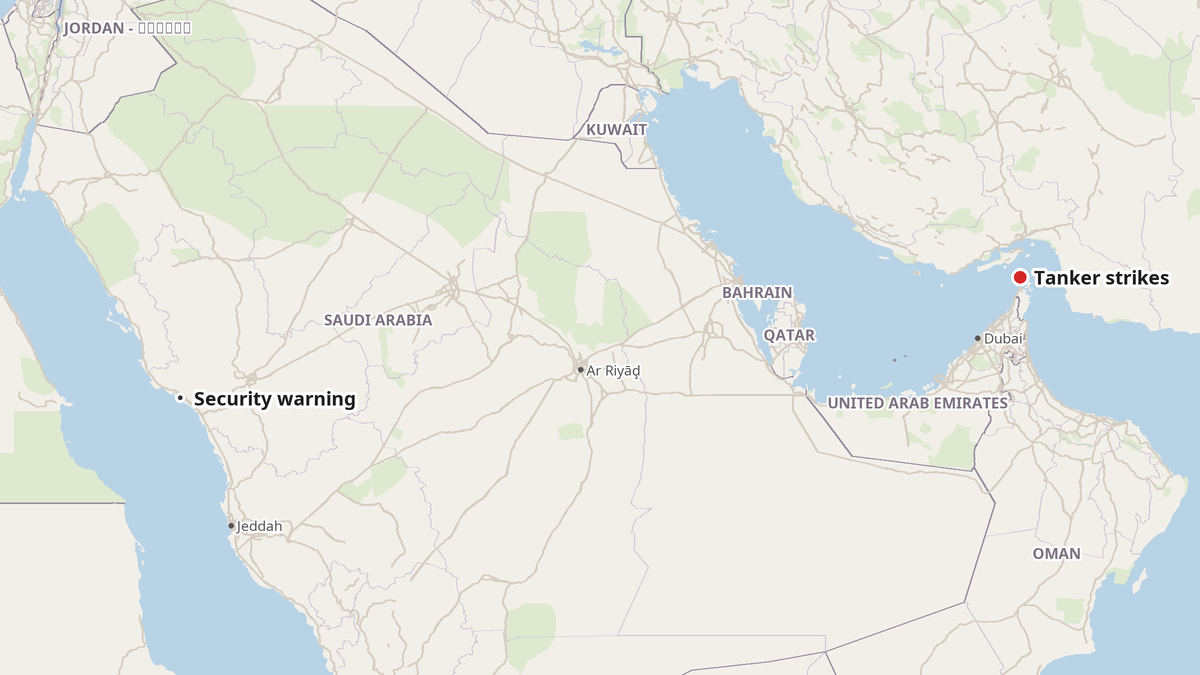
A tanker was hit by two projectiles about 50 nautical miles, roughly 93 kilometres, north of Qatar's Madinat ash-Shamal at 23:20 GMT on Wednesday, the United Kingdom Maritime Trade Operations (UKMTO) said. The agency didn't name the ship or its flag. Nobody claimed responsibility. And as of the latest reports, the crew's condition, the extent of the damage and any environmental impact remained unconfirmed.
It was one of several incidents in a single day. Iranian forces said at least five tankers were damaged in the Strait of Hormuz. The Islamic Revolutionary Guard Corps (IRGC) told the Fars news agency that a large oil tanker caught fire after striking a mine south of the strait and was brought to a halt. It said a second supertanker caught fire while leaving the eastern strait, and that a tugboat sent to put out that fire caught fire too. Iran's army later said three more tankers struck naval mines. Those accounts haven't been independently confirmed. The IRGC blamed the United States for encouraging vessels to use what it called an "illegal passageway."
The Human and Economic Toll at Sea
The strait normally carries about one-fifth of global oil consumption, and Iran has severely restricted traffic through it since the war began in late February. The conflict started with US-Israeli strikes on Feb. 28 and is now in its ninth month. Tehran responded by firing missiles and drones at Gulf targets and at shipping, disrupting global energy supplies.
The true scale of the danger at sea is hard to measure. UKMTO said last month it was "struggling to accurately report" the number of attacks because most ships now refuse to report them. Last week, the Qatari liquefied natural gas carrier Al Mayeda was struck by "unidentified objects" in the Gulf. Nakilat, its operator, said no crew members were hurt. Every one of these vessels carries sailors who have no say in the dispute above their heads.
For residents across the Gulf, the worries are practical. Gulf News pointed to regional air-travel safety, the flow of oil and goods through Hormuz, and the chance of a wider conflict reaching neighbouring countries. It said further attacks, shipping restrictions or changes to insurance conditions could hit commercial traffic and energy supplies.
Diplomacy Under Pressure
Qatar has stepped up mediation. Its Foreign Ministry spokesperson said Tuesday that both sides were reviewing mediator proposals and talks were continuing. Gulf News reported that mediators were seeking support for a draft with confidence-building measures, after which direct talks could follow. No date has been set, and neither side has publicly accepted a final settlement. Iran wants the US naval blockade lifted, sanctions eased and frozen funds released, and it has tied reopening Hormuz to those demands.
The New York Times, as cited by The Jerusalem Post, reported that Iran is reviewing "concrete proposals" from mediators on its nuclear program. It also reported that a growing number of Iranian clerics and officials are pressing their leaders to reverse a pledge not to pursue nuclear weapons. Supreme Leader Mojtaba Khamenei warned against "even the slightest inclination toward submission."
Meanwhile, thousands of US air and naval forces, aboard more than a dozen ships and at bases in the region and the United States, were poised to resume major combat operations on President Donald Trump's orders, Pentagon officials told The New York Times. Gulf News said preparations didn't mean Trump had ordered new attacks, and Trump said he was in no rush to decide. Vice President JD Vance was reported to favor a negotiated settlement.
After the Midterms
Democrats won control of both the House and the Senate in the November 3 midterms. Trump acknowledged the war contributed to the defeat, particularly through higher fuel prices, but said he would do it again to stop Iran from developing a nuclear weapon.
Gulf voices read the result in opposing ways. Ebtesam al-Ketbi, president of the Emirates Policy Center in Abu Dhabi, said, "The U.S. election results make a settlement more urgent for U.S. President Donald Trump, but no easier for Iran." Abdulaziz Sager, chairman of the Saudi-based Gulf Research Center, argued the opposite risk: with no third term ahead, Trump has less to lose and might want to "finish the job." A Hezbollah official put it bluntly: "At this moment, the chances of escalation and deescalation may be equal."
Deportations Amid War
Court documents unsealed Thursday showed that Trump's administration held secret talks with Iran about deporting Iranians while the war continued. As recently as mid-October, the administration planned to deport Iranians through an unnamed third country. In an Oct. 15 transcript, Judge Ana Reyes said the government was proposing to send people back to a country it calls an enemy, facing "a serious threat of certain death." Justice Department attorney Dimitar Georgiev-Remmel replied, "Yes, your honor. The government is executing lawful orders of removal."
Hundreds of emails showed the two governments working together to fly more than 100 Iranians to Iran on three flights between September 2025 and January 2026. The Department of Homeland Security has denied sharing asylum application records with Iran. The judge ordered 24-hour notice of finalized plans and five days' written notice before any deportation.
Why This Matters: The fires in Hormuz and the projectiles off Qatar show how quickly a stalled negotiation can turn deadly for people with no part in the decision-making: merchant crews, port workers, and families across the Gulf who feel it in fuel and insurance costs. Diplomacy is moving, but so are warships, and the gap between the two is where civilians pay. The court case adds another human dimension, since Iranians who fled their government now face removal to it. Reporting suggests a negotiated end remains possible, but each unclaimed attack makes the trust needed for one harder to build.
- strait of hormuz
- iran
- tanker attacks
- qatar
- nuclear talks
- united states
- maritime security
- iran nuclear program