
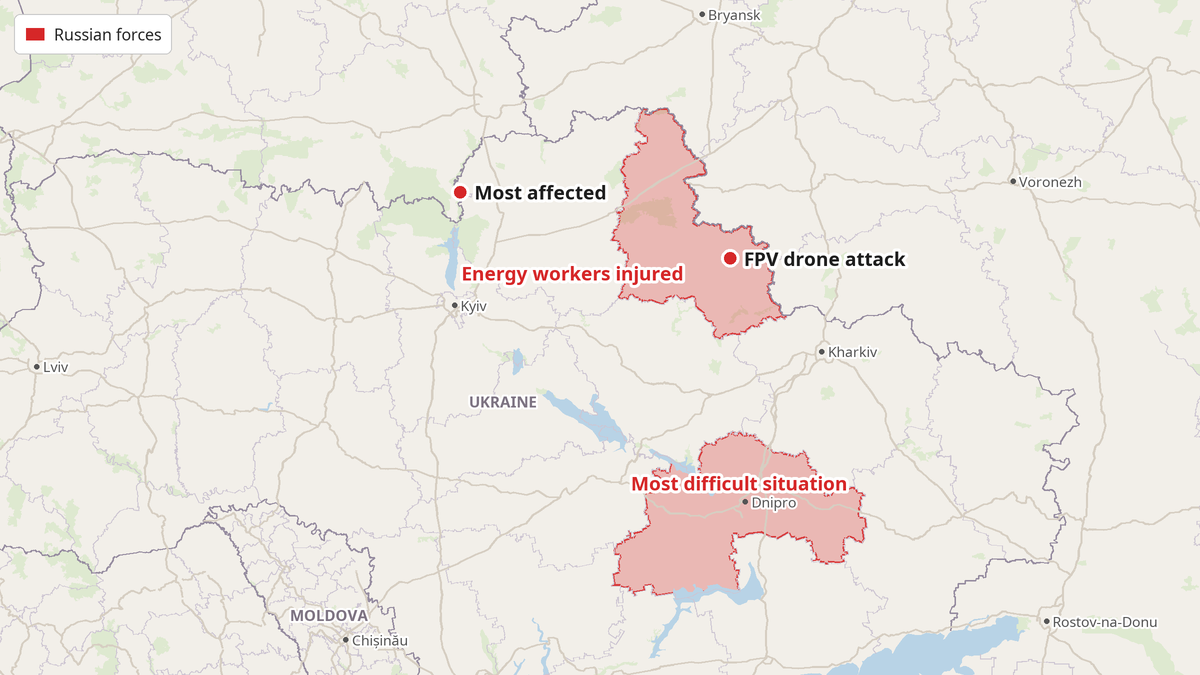
Russia attacked Ukraine's energy and oil and gas sectors 128 times between 2 and 8 November, according to Artem Nekrasov, First Deputy Minister of Energy, who briefed reporters on the state of the power grid. The ministry logged 219 incidents that damaged or destroyed energy and oil and gas facilities. As of Monday, 9 November, the situation remained hardest in Dnipropetrovsk and Kyiv oblasts.
The scale is hard to overstate. Consumers in 12 oblasts were without electricity on the morning of 9 November: Vinnytsia, Dnipropetrovsk, Donetsk, Zhytomyr, Zaporizhzhia, Kyiv, Odesa, Poltava, Rivne, Kharkiv, Khmelnytskyi and Chernihiv. Emergency power cuts hit Sumy, Poltava and Kharkiv oblasts in the morning, and the grid operator Ukrenergo suspended previously announced outage schedules there.
The Grid Under Pressure
A Russian mass strike on 3 November was the largest attack on Ukraine's energy facilities this year. It caused widespread outages and cut water supplies across Kyiv for more than 24 hours. The following day, 4 November, Ukrainian nuclear power plants were forced to reduce generation capacity because of what Nekrasov called large-scale and systematic Russian attacks.
Russia has increasingly gone after power lines as temperatures fall, and repeated strikes have forced authorities into rolling blackouts and emergency cuts. Overnight on 9 November, power lines were hit in the village of Zolochiv, Kharkiv Oblast, and in the city of Kharkiv, according to Oleh Syniehubov. Odesa Oblast authorities reported massive attacks on the grid, and an energy facility was struck in Rivne Oblast.
For households, the arithmetic is punishing. Outages of 1.5 to 4 queues will apply in most oblasts throughout 9 November, meaning consumers could go without electricity for up to 16 hours a day. Ukrenergo defines a queue as a group of consumers and businesses drawing a specific amount of megawatts, and the Dispatch Centre sets how many queues are needed to cover energy deficits. Supply can change several times an hour, and the Ministry of Energy urges the public to follow announcements from the regional distribution companies.
Workers in the Line of Fire
The people repairing the network are themselves targets. A Russian FPV drone struck a vehicle carrying Ukrainian energy workers in Sumy Oblast on 9 November and injured three of them, Ukrenergo reported. All three were taken to hospital, and one is in critical condition. Ukrenergo said Russian forces deliberately targeted workers responsible for maintaining and repairing damaged infrastructure. "Today's attack is yet another testament to the price paid for this work," the company said.
Nekrasov said the repair crews keep going regardless. "Despite the constant attacks and danger, power engineers work daily to restore the electricity supply. Repair work is underway in all affected regions where the security situation allows," he said. "Power engineers are working flat out to restore stable power supply to consumers as quickly as possible."
Protecting What Can't Be Cut
Not every consumer faces the same cuts. Under a Ukrainian Cabinet resolution, critical infrastructure and eligible industrial companies that import at least 60% of their energy cannot be disconnected. The rule shows how Kyiv is rationing scarce supply between households and the industrial base that keeps the economy running.
Why This Matters:
The figures from the Ukrainian Energy Ministry, 128 attacks and 219 damaged facilities in a single week, show an energy system under sustained, systematic assault as winter approaches. For European governments, this carries concrete implications. Ukraine's ability to keep power, water and industry running determines how much more pressure its civilian population can bear, and how long it can sustain the war effort that European taxpayers are helping fund. It also underlines a lesson Europe has been slow to absorb: energy networks are strategic assets that demand hardening and defence, not just investment. Member states weighing their own spending priorities will note that protecting critical infrastructure is a national responsibility long before it becomes a European one.
- russia
- ukraine
- power outages
- energy infrastructure
- ukrenergo
- kyiv
- military attacks
- rolling blackouts