
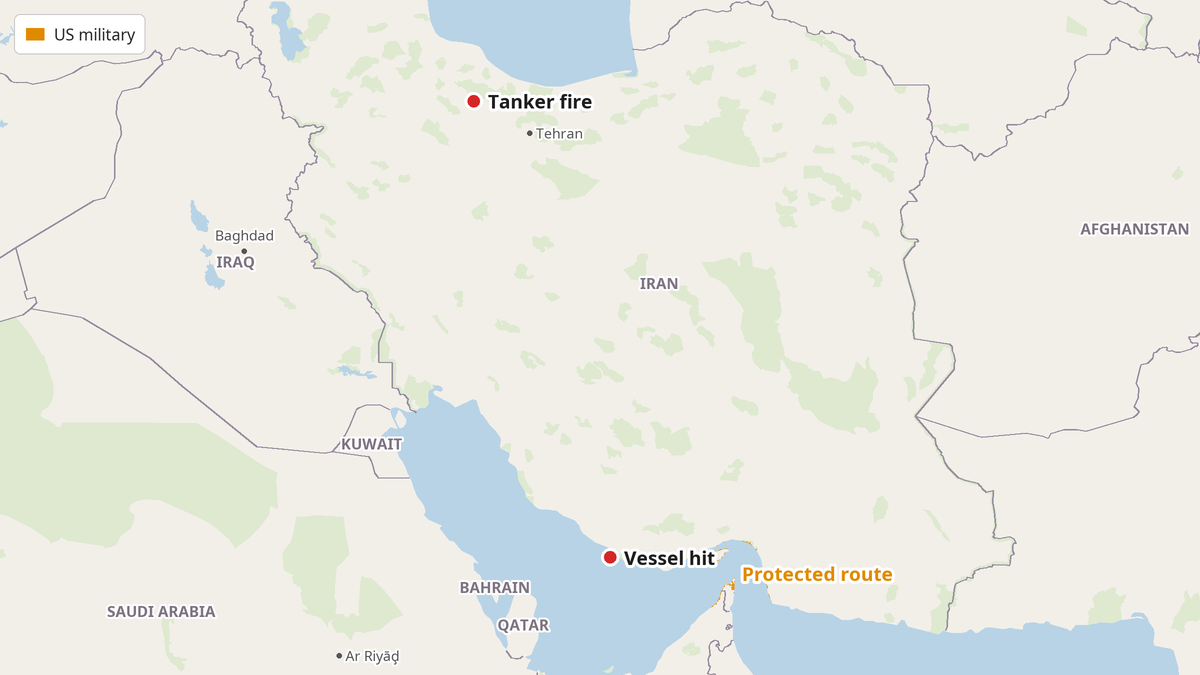
Twenty-five sailors were pulled from a burning Panama-flagged tanker off Oman's coast on Friday, rescued after their ship was attacked and set ablaze near Musandam governorate, close to the Strait of Hormuz. Omani authorities announced the evacuation but didn't immediately say who had struck the vessel or whether it was among the tankers Iran later cited. For the crew, the questions of blame came second to getting off a ship on fire.
It was one of several incidents in a single day. The United Kingdom Maritime Trade Operations agency (UKMTO) said a vessel was hit on its port side by an unidentified projectile roughly 40 nautical miles (74 kilometers) south of Iran's Lavan Island in the Persian Gulf, sparking a fire. The crew was reported safe, and no environmental damage had been reported. In a separate report, UKMTO said an oil tanker had been struck by an unidentified projectile as it left the Strait of Hormuz. The agency didn't name those responsible in either case.
Competing Claims at Sea
Iran's Islamic Revolutionary Guard Corps (IRGC) offered its own account. It said four oil tankers had caught fire after explosions in the waterway, claiming they struck naval mines after ignoring Iranian navigation warnings. According to the IRGC Navy, the fourth tanker was carrying more than two million barrels of crude oil when it hit a mine, setting off a powerful explosion and fire. Iranian officials said the tankers had tried to cross on routes Tehran hadn't authorized, and Iranian state media reported that some vessels had switched off their navigation and tracking systems before entering dangerous areas. Iran also reported that three oil tankers were halted while transiting.
None of that could be independently verified. It also remained unclear whether the vessels in the British maritime warnings were among the four the IRGC described. What's certain is that crews on commercial ships, people with no role in the war's strategy, are the ones standing on decks when the fires start.
A War Now About Shipping Lanes
The strait connects the Persian Gulf with the Gulf of Oman, and under normal circumstances roughly one-fifth of global oil supplies pass through it. Since the war began in late February, now about eight months ago, Iran has intensified its efforts to control shipping there, repeatedly warning that vessels crossing without its authorization risk attack. The US-Iran war has become focused on these shipping lanes, where Iran tried to stop energy exports from the region in response to the initial US-Israeli attacks.
The US, for its part, is enforcing a blockade on Iranian ports and flying nightly missions over the waterway, according to a Wall Street Journal report on Thursday. Airspace over the strait is only about 20 miles wide but crowded with aerial objects, US service members told the Journal, leaving fighter pilots a narrow window to react to projectiles launched from Iran's coast. Rear Adm. Jeffrey Heames, who commands the USS George Washington Carrier Strike Group, said US forces have been reliably striking down threats. "If there's a threat that's launched against those vessels, whether it's an anti-ship cruise missile or a drone, those aircraft will go in and intercept it and shoot it down in a very short amount of time," he said.
Washington's Account of Security
US Central Command (CENTCOM) says the Navy's protection has let Gulf partners export over 1.5 billion barrels of crude oil since the summer, and that more than 3,000 commercial vessels have transited the strait without incident over the past six months. In a video statement on Friday, CENTCOM head Adm. Brad Cooper said Iran hasn't been able to export any oil since the blockade began. "Iran's Navy is all at the bottom of the sea," he said, adding, "I didn't see the IRGC out there, at all." He said US forces were keeping the shipping lanes free of Iranian sea mines after a major clearance operation. Arab News reported that oil shipments have climbed back to pre-war levels despite ongoing Iranian attacks.
The picture Cooper describes sits awkwardly beside Friday's fires. Both can be true at once: thousands of safe transits, and a burning tanker with 25 people aboard.
The Strain on the Forces Doing the Work
The operation is wearing on the people carrying it out. US officials told the Journal the nightly missions have strained aircraft, crews and the mechanics who maintain fighter jets. Adm. Daryl Caudle, chief of US naval operations, said the Navy is accounting for the strain and has set up a ship maintenance hub on Diego Garcia. He said more port calls are planned after personnel aboard the USS Abraham Lincoln completed a record-breaking 286 days at sea. Ensign Addie Schaefer, an officer in that carrier's maintenance department, said the more aircraft fly, the more prone they are to damage and wear.
US military leaders say they can hold the blockade as long as needed, though some officials worry the effort may limit the US's ability to respond to crises elsewhere. According to the Journal, the US has 50,000 troops and 20 ships deployed in the Middle East, at a cost of between $2 billion and $3 billion a month.
Why This Matters: A chokepoint carrying a fifth of the world's oil supply has become the main front of a war now about eight months old, and the people exposed to it include merchant crews who had no part in starting it. Friday's incidents show how hard accountability becomes when projectiles are unidentified, mines are disputed and each side's account can't be verified. The US describes a secure strait while ships still burn, and Iran blames the vessels' own conduct. Meanwhile the financial and physical toll on American forces mounts at $2 billion to $3 billion a month. Without a diplomatic track, the burden of this standoff keeps falling on sailors, maintenance crews and the economies that depend on open shipping lanes.
- strait of hormuz
- tanker attacks
- iran
- us-iran war
- naval mines
- persian gulf
- uk maritime trade operations
- us central command