
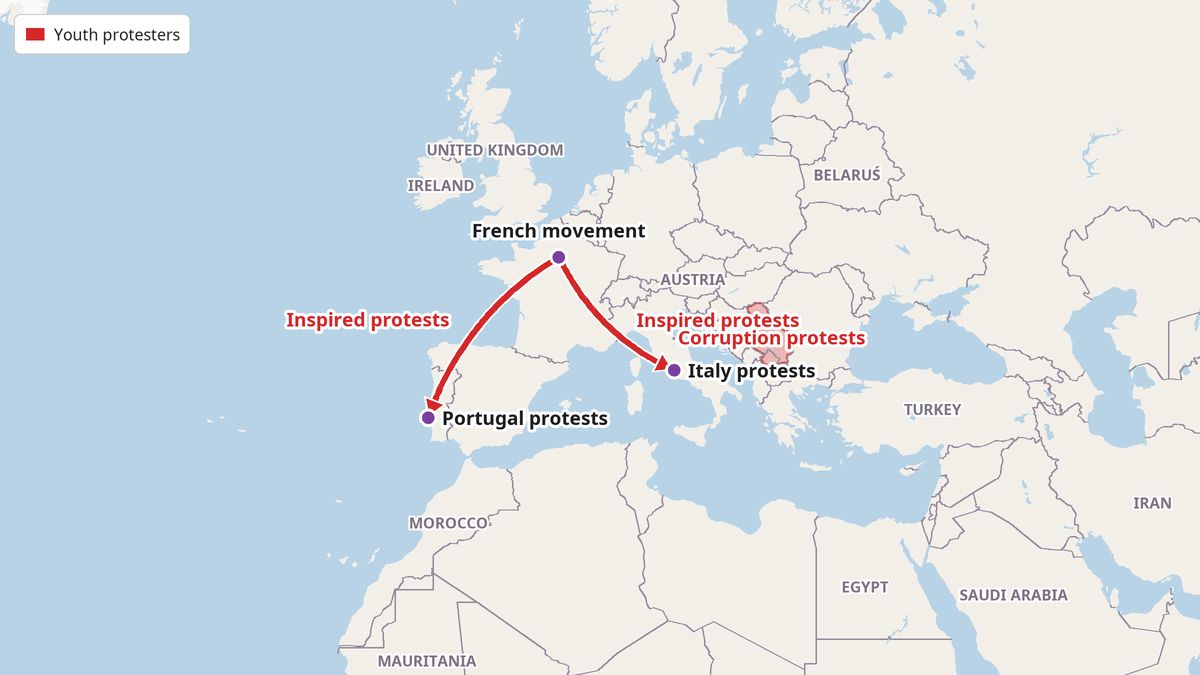
In France, 320,000 people marched for a third straight weekend, according to the interior ministry. By Saturday, October 31, the protests that began there had spread to Portugal, Italy and Germany, drawing hundreds of thousands of people into overwhelmingly peaceful youth-inspired marches across the continent.
The scale is hard to dismiss. So is the message.
Human Impact
Germany saw particularly large rallies, led by a youth initiative whose name roughly translates as "Gen Z has got this." Demonstrators called for better education and healthcare, stronger climate protection and a more affordable cost of living. They also made clear they oppose any return to compulsory military service.
The demands aren't exotic. They're the basics of a decent start in adult life: a school that works, a doctor you can see, a planet that stays livable, a rent you can pay.
In Lisbon, thousands marched to demand more affordable housing, carrying signs criticising the government of Prime Minister Luis Montenegro. Some of the protesters have been out for weeks, inspired by the Spanish movement, over rising living costs, especially housing. A few hundred had camped out in Rossio, an iconic square in downtown Lisbon. Riot police removed them by force overnight. Police intervened early Sunday, removing tents and pushing people away, and a few were detained.
Unrest at the Margins
Not everything stayed peaceful. Protests in several major German cities turned violent towards the end of the day, particularly in Frankfurt. bne IntelliNews reported that the wave has also reached Belgium, Italy, with clashes in Milan, Turin and Bologna, and Spain. There, Catalan police raised their alert to the highest level after rioting in Barcelona on October 24 led to about 130 arrests, most of them minors.
In Albania, students have been on the streets since October 13 demanding Prime Minister Edi Rama's resignation.
The pattern is worth stating plainly: the great majority marched peacefully, while violence at the edges and heavy-handed policing captured much of the attention.
A Generation's Grievance
Thomas Fazi wrote in UnHerd on November 1: "These are the protests of a generation that believes it has been robbed of its future." The triggers differ by country, Fazi argued. Schools in France and Belgium, housing in Spain and Portugal, the cost of living in Italy and corruption in Serbia. But the social contract their parents knew has collapsed, he wrote.
bne IntelliNews linked the unrest to a cost-of-living crisis that it said started with an energy shock and has been worsened as governments divert money to rearmament and the war in Ukraine.
The political stakes are visible in the numbers. According to Fazi, a third of French under-25s backed the Rassemblement National in 2024, and more than a quarter of young German men voted for the Alternative for Germany (AfD), which tops national opinion polls.
Why This Matters: These marches show young Europeans demanding investment in schools, healthcare, housing and climate protection rather than retreating into resentment. The reported figures on young voters backing the Rassemblement National and the AfD suggest what's at stake if those demands go unanswered. For governments, the message is that stretched budgets and competing priorities, including rearmament, carry a human cost that falls hardest on the youngest. A continent-wide wave points to problems no single capital can fix alone, and it puts pressure on both national governments and EU institutions to show that the social contract can be renewed with affordable homes, decent public services and a credible climate plan. Heavy policing, as in Lisbon, won't answer the grievances behind the protests.
- youth protests
- europe
- germany
- france
- portugal
- housing costs
- cost of living
- student protests