
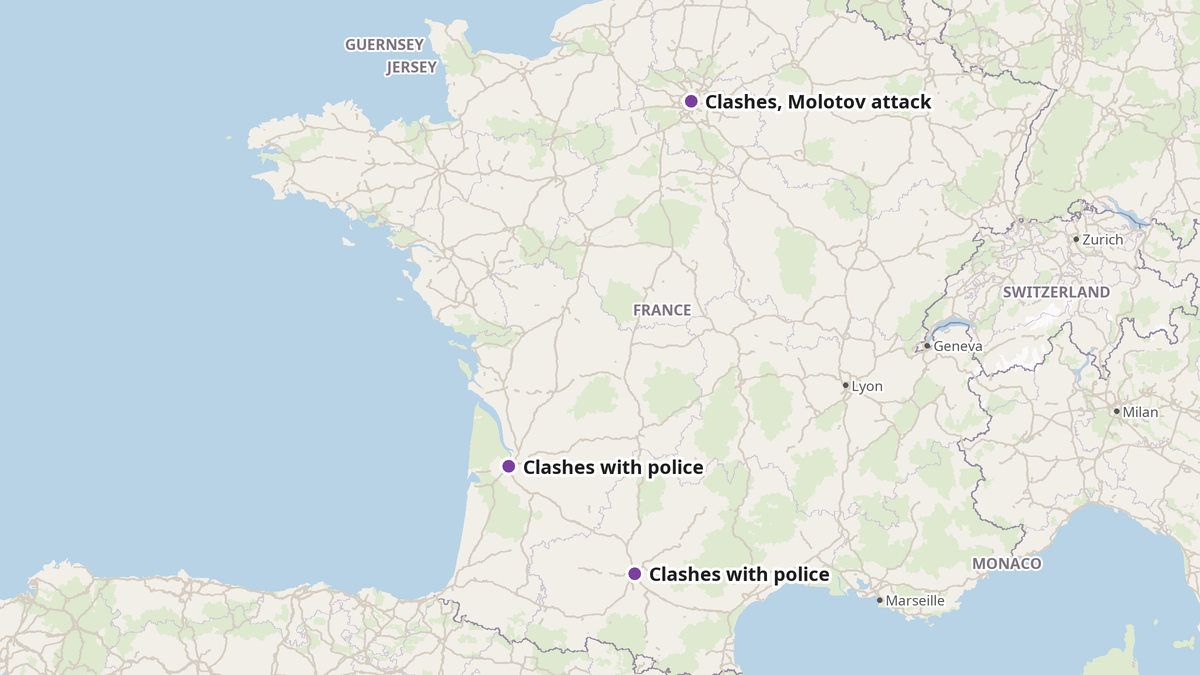
France opened an attempted murder investigation Sunday after petrol bombs were thrown at security forces during a weekend protest in Paris, prosecutors told AFP. "Explosive devices were thrown at around 15 gendarmes as well as police officers," the prosecutor's office said. The inquiry covers "attempted murder of persons vested with public authority."
The violence overshadowed what was, by the numbers, a vast show of generational anger. On Saturday, October 31, hundreds of thousands of people marched for a third consecutive weekend against soaring living costs and deteriorating school conditions. The interior ministry put turnout at 320,000, including 70,000 in Paris. A coalition of youth groups and student unions claimed nearly half a million, according to bne IntelliNews. France 24 called the day "Act III."
The Violence
AFP photos and video showed a homemade incendiary device exploding at the feet of a security officer in eastern Paris, engulfing his lower body in flames. Prosecutors said reported injuries include second-degree burns, and that an assessment of the injured was ongoing. The gendarme told French television of "skin that stings" and a "rain" of projectiles thrown at his unit. No suspects had been arrested at that stage.
AP reported that rioters targeted police with Molotov cocktails at the end of the march on the city's eastern edge, injuring three officers and setting a car ablaze. Masked groups hurled fireworks at officers near the Eiffel Tower, sending tourists fleeing. Protesters prised up paving stones and threw them at police, who answered with tear gas and baton charges, according to bne IntelliNews. Police also fired tear gas in Lyon.
Interior Minister Laurent Nunez decried an "extraordinary" level of violence from some rioters. Far-right leader Marine Le Pen said those responsible must be "punished with the utmost severity." More than 770 people were arrested over the weekend, the interior ministry said. That compares with 2,628 on October 17 and 1,314 the previous weekend. About 70,000 police were deployed nationwide.
Less Damage, Same Grievances
Authorities expressed relief that the violence was less severe than on October 17, when a city hall was torched and more than 2,000 stores were looted in hours of unrest that authorities seemed unprepared to control. About 20 businesses were affected Saturday, according to France's Chambers of Commerce and Industry. CCI France voiced concern about retail activity ahead of the year-end holiday season.
The movement began in the lycées on September 17 over dilapidated school buildings, teacher shortages and the Parcoursup university admissions system. That's six weeks of sustained mobilisation by teenagers and students asking for functioning classrooms.
The Policy Gap
The government announced measures aimed at student demands, including replacing the university admissions platform and providing loans for school renovations. Students said the proposals fell short. President Emmanuel Macron called for classes to resume calmly, arguing that "young people have been heard."
Pierre Sourzat, head of the "Lycéens!" group, disagreed sharply. "The president hasn't listened to us. It's smoke and mirrors," he told RMC. "There's a bit of polish on the surface, but once you scratch beneath it, there's nothing there." He said the new admissions platform doesn't address the shortage of higher education places. The plan to reduce class sizes would apply only to 10th-grade classes. "We were asking for all year groups," he said.
France 24 reported that with the eurozone's second-largest economy on the brink of recession and under pressure to rein in its debt, the government has limited scope to appease protesters through additional spending.
What Comes Next
High schools reopen Monday after the autumn break, and police are preparing for more tension, a national police official told AP. Sourzat said blockades would restart Monday. "It will be more significant from Tuesday, but we know that some schools will be blocked as early as tomorrow." Sabrine Kharbach, spokeswoman for the Union Etudiante, said blockades of universities and high schools would take place Tuesday and Thursday. Student groups and labor unions have called for nationwide protests on both days.
Why This Matters: A petrol bomb attack on officers is a serious crime, and the investigation is rightly under way. But the violence of a few shouldn't bury what hundreds of thousands marched for: school buildings in disrepair, too few teachers, too few university places and rising living costs. The government's response, by students' account, doesn't match the scale of those grievances, while its fiscal room for manoeuvre is narrow. That tension, between young people's demands and a debt-constrained state, is likely to define the coming days as classrooms reopen and unions join the call to protest.
- france protests
- paris
- student protests
- cost of living
- marine le pen
- emmanuel macron
- laurent nunez
- parcoursup