
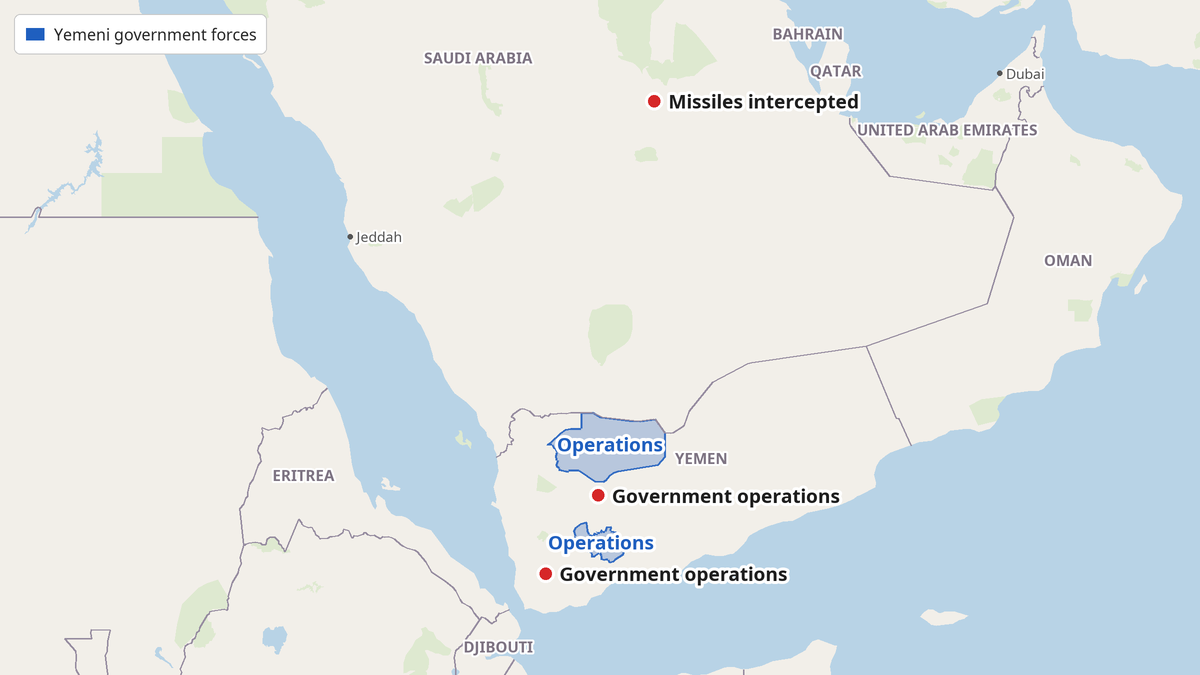
Yemeni government forces said Wednesday they carried out 773 field artillery bombings, 44 drone strikes, 37 rocket attacks and 23 air strikes against the Houthis, killing and wounding 138 fighters and damaging 86 heavy weapons and military vehicles. The numbers came from Majed Abdullah al-Nuzaili, a spokesperson for the Saudi-backed government's forces, who posted them on X.
That's a heavy day of fighting. And it isn't over.
The Battlefield Picture
Nuzaili said operations against the Houthis continue in al-Jawf, Marib, al-Bayda, Taiz and the southern sectors. The scale of the reported bombardment, spread across five fronts, points to a conflict that remains active well beyond any single flashpoint.
The Houthis are the Iran-aligned movement known as Ansar Allah, Arabic for "Supporters of God." Middle East Eye reported separately that the group is bombing Saudi Arabia as it looks to extend its territory in Yemen. In other words, the fighting isn't contained inside Yemen's borders. A militia armed and aligned with Tehran is targeting a neighboring state while pressing for more ground at home.
The Yemeni government's figures are its own claims, issued through a spokesperson, and the base reporting offers no independent verification of the casualty or equipment totals. They nonetheless show the intensity of the government's response and the breadth of the front lines.
Tehran Offers to Mediate
Iranian parliament speaker and top negotiator Mohammad Bagher Ghalibaf addressed the fighting in an interview with Al Jazeera. On the clash between the internationally recognised Yemeni government forces and the Houthis, he said "no one should interfere."
He then added an offer. "If both the government in Yemen and Saudi Arabia were to ask for our help, we would certainly offer our assistance to help resolve their conflict," Ghalibaf said.
The framing deserves scrutiny. Iran presents itself as a neutral helper, yet the Houthis it's offering to help manage are aligned with Iran. Tehran is casting itself as a broker in a fight involving its own partner. Iran also previously offered to facilitate talks between Saudi Arabia and the Houthis in October, following a series of deadly attacks on the kingdom, about one month ago. The offer has come twice now, each time after Houthi violence against Saudi territory.
No response from Riyadh or the Yemeni government to Ghalibaf's latest proposal appears in the reporting.
What Comes Next
The Yemeni government says its operations are continuing across multiple provinces. The Houthis, per Middle East Eye, are still striking Saudi Arabia while seeking to widen their footprint in Yemen. Iran, for its part, is signaling a willingness to step in as a facilitator, but only if invited by both the Yemeni government and the kingdom.
Several reports covering related events, including intercepted missiles toward Riyadh, airport damage, a G7 statement, a Yemeni minister's remarks on foreign commanders, and conditions in Sanaa bakeries, could not be retrieved, so those details are not included here.
Why This Matters: The Houthi campaign shows how Iran's network of aligned armed groups can pressure a regional rival without Tehran firing a shot itself. When an Iran-aligned militia bombs Saudi Arabia while expanding its holdings in Yemen, Gulf states face a security problem that diplomacy alone doesn't solve. Iran's repeated mediation offers, issued after attacks on the kingdom, put the party with influence over the aggressor in the role of peacemaker. From a security standpoint, that arrangement rewards leverage rather than restraint. The Yemeni government's multi-front offensive suggests it doesn't intend to negotiate from weakness, and Riyadh will weigh any Iranian offer against the attacks that preceded it.
- houthis
- yemen
- saudi arabia
- yemeni government forces
- iran
- mohammad bagher ghalibaf
- majed abdullah al-nuzaili
- military strikes