
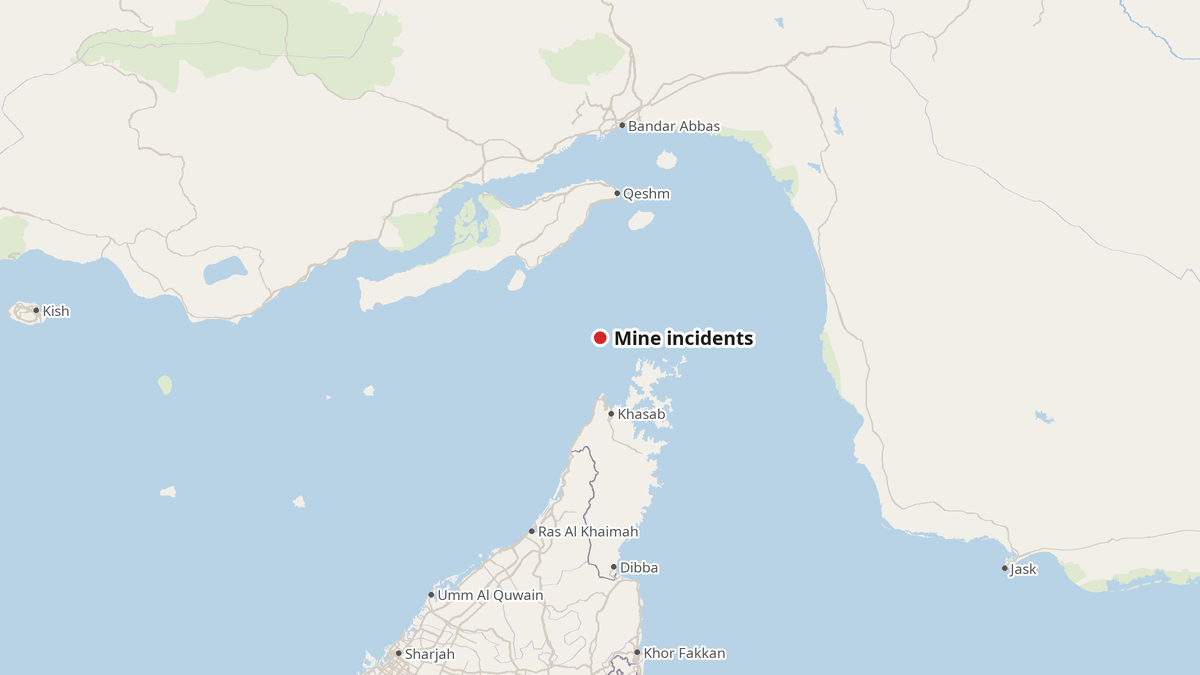
Three tankers caught fire after hitting mines in the Strait of Hormuz within the past 24 hours, Iran's Islamic Revolutionary Guard Corps navy said Friday, while a fourth vessel struck naval mines in the eastern part of the waterway. The IRGC said the ships were trying to cross an unauthorized route south of the strait, had switched off their radar and navigation systems, and ignored warnings from its naval forces. It said the vessels were abandoned on the southern shores of the strait. Who laid the mines? That remains unclear, as does whether anyone was hurt.
The United Kingdom Maritime Trade Operations separately reported a vessel on fire about 25 nautical miles northeast of Khasab, Oman, travelling outbound through the strait. The cause, the crew's condition and any environmental damage weren't established. UKMTO told ships to transit cautiously and report suspicious activity.
The Military Picture
The fires came as Washington moved closer to decisions about Iran. The Wall Street Journal reported that the top US commander overseeing the Middle East met President Donald Trump at the White House on Thursday and presented military options. Defense Secretary Pete Hegseth and Joint Chiefs Chairman Dan Caine attended, and US Central Command chief Adm. Brad Cooper laid out the choices. Reuters said it couldn't independently verify the report.
The meeting followed reports the previous week that Washington and Jerusalem were weighing a "short but intensive operation" of renewed strikes on Iran after the November 3 US midterm elections, four days from now. Drills had ramped up, targeting Iranian energy sites, nuclear facilities, and arsenals of missiles and drones. Trump could still decide against action, the report said.
The buildup is visible. Analysts tracking open-source flight data counted more than 10 US military transport aircraft landing at Israeli airbases in southern Israel over the past week. Most recent cargo flights departed Biggs Army Airfield in El Paso, Texas, bound for the Israeli Air Force's Nevatim and Ovda bases. Other flights went to American bases in Jordan, Saudi Arabia, Qatar and Kuwait. The cargo's contents were unknown, but the flights were thought to be tied to efforts to bolster regional air defenses. The Wall Street Journal reported Wednesday that a Patriot battery was being sent from Texas.
Tehran's Narrative, and Its Record
Iran's UN ambassador, Amir-Saeid Iravani, told the Security Council that Washington and its supporters were responsible for insecurity in Hormuz and disrupted regional shipping. He called the US naval blockade a violation of the UN Charter and "collective punishment" of Iranians, citing threats to food, medicine and fuel. The United States said the blockade was effective and that no Iranian ship had crossed the strait.
Foreign Ministry spokesman Esmaeil Baghaei, meanwhile, attacked UN Special Rapporteur Mai Sato, calling her mandate "politically motivated." Her report to the General Assembly had said US and Israeli military actions compounded Iranians' suffering. It also said authorities in Tehran had used the regional conflict to intensify a crackdown on dissent through arrests and executions. Tehran's response targeted the messenger, not that finding.
Diplomatic Dead End, or Opening?
Iran confirmed it had received a letter from Vice President JD Vance but hadn't responded, Tasnim reported. The agency said Tehran still insists on seven conditions for the United States, adding that "any position that contradicts this framework is unacceptable." It didn't list them. Trump said Vance's outreach was about medical supplies, and when asked if he'd directed Vance to restart negotiations, he said, "No."
The Washington Post, as relayed by the Times of Israel, reported that US intelligence considers security chief Mohsen Rezaei the best option to head off renewed fighting. An official said Vance urged Iran to send negotiators "empowered" to resolve the nuclear issue. The goal, the official said, is preventing a nuclear-armed Iran. Rezaei hasn't answered, and his longstanding hardline stance toward the United States casts doubt on whether he'll pursue a deal. Russia said it was ready to mediate if asked, and Qatari mediators returned to Tehran Friday in talks coordinated with Washington, an official told Reuters.
The Wider Stakes
The war's effects on energy, shipping and trade dominated a G20 foreign ministers' meeting in Atlanta hosted by Secretary of State Marco Rubio. A State Department official said ministers would discuss "threats to freedom of navigation, energy and food security, and supply chains." Turkey planned to urge dialogue and highlight attacks on ships and energy infrastructure in the Gulf. France planned to press for maritime-security cooperation in Hormuz and Bab Al Mandeb. French diplomatic sources said no joint declaration was expected.
Why This Matters: Mines in one of the world's key energy chokepoints, a US blockade, and an air-defense buildup across the Gulf and Israel all point the same direction: a confrontation that diplomacy hasn't defused. Tehran still sets seven conditions while its security chief sits on a US letter, and its record of silence and deflection gives Washington little reason to assume good faith. From this perspective, the strategic question is whether pressure, including credible military options, is what finally brings empowered Iranian negotiators to the table on a nuclear program Washington says it won't allow. The alternative is a maritime-security vacuum where unattributed mines decide who can trade.
- strait of hormuz
- iran
- united states
- islamic revolutionary guard corps
- maritime mines
- military tensions
- peace negotiations
- mohsen rezaei