
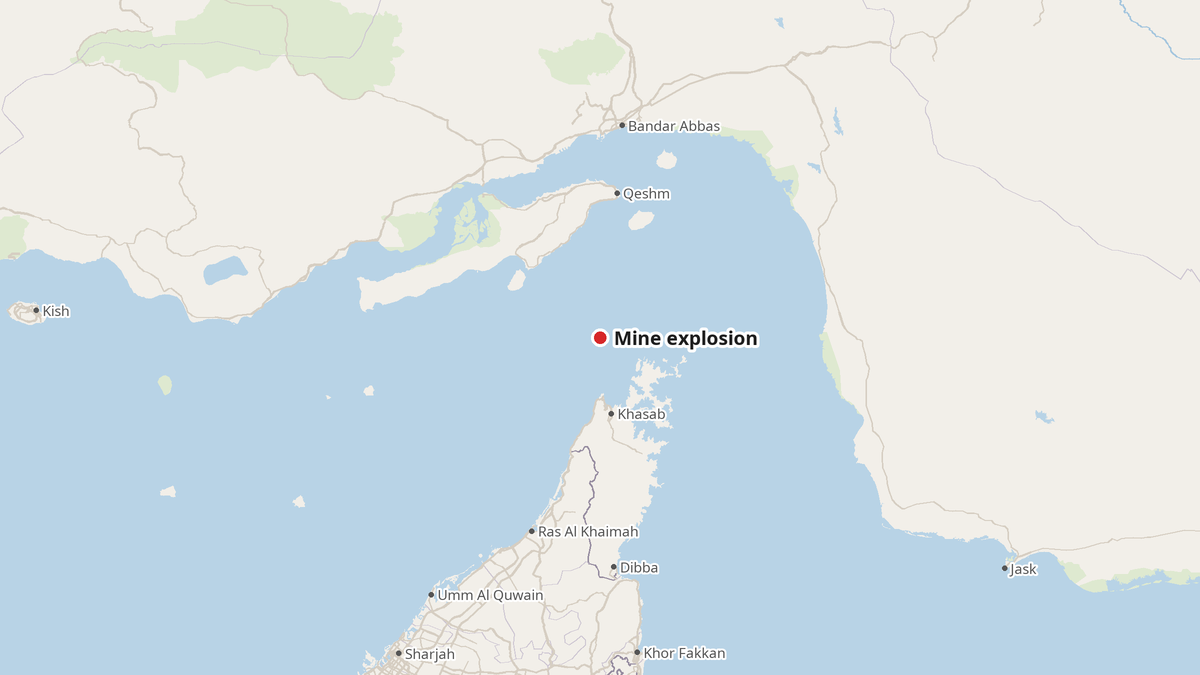
Iran's Revolutionary Guards navy announced Friday that a tanker carrying liquefied gas struck a naval mine and exploded in the Strait of Hormuz, Iranian state media reported. The Guards said the vessel was on an "unauthorised and dangerous route." Nobody could verify any of it. The ship wasn't named. Nobody said whether anyone was hurt. The extent of the damage is unknown.
What's known comes from a military force announcing its own account of an explosion in waters it claims the right to police. The Guards told IRNA the vessel ignored repeated warnings while transiting the eastern part of the strait. AP, citing IRNA, said there was no immediate report from the United Kingdom Maritime Trade Operations, the British military agency that monitors incidents at sea. So the only witness is the party with a stake in the story, and the only referee is another state's navy.
Even the cargo is contested. Reuters copy carried by the Times of Israel and L'Orient Today said the type of gas wasn't specified. The New Arab and Ynet called it liquefied natural gas. AP, relaying IRNA, called it a liquefied petroleum gas tanker. Same ship, same blast, three different cargoes. That's the fog in which the crews who actually sail these lanes get blown up.
The State's Monopoly
The permission slip is the point. Iran continues to warn ships not to pass through the strategic lane without its approval, and the Guards frame a mined vessel as the captain's fault for choosing the wrong route. A naval force claims the sea as its property, scatters hazards in it, then cites the wreckage as proof its rules were broken. The crews, who don't write the rules and don't sign the war plans, absorb the risk.
The Friday incident wasn't an isolated one. Iranian media reported Thursday that four oil tankers were hit by explosions after ignoring warnings and entering what Iran considers restricted areas. On November 12, RFE/RL reported, Iran's army said two oil tankers caught fire after hitting naval mines in the eastern part of the strait. Earlier in the week, the IRGC claimed explosions on two supertankers carrying more than four million barrels of oil.
Who Gets Crushed
The numbers keep climbing. According to Washington Institute for Near East Policy data, at least 10 ships were hit in the first 10 days of November, after 37 attacks in October, the highest monthly tally since the conflict began in late February. We're now in the ninth month of the conflict, the US-Israeli war on Iran, and the strait has become a minefield that sailors cross for wages while capitals argue over leverage.
Traffic has rebounded anyway, and oil prices are falling on expectations of de-escalation. Read that twice. Ships keep getting hit, and the market prices in calm. The people on deck aren't part of the calculation.
Both Sides of the Same Coin
Washington's contribution arrived on the same news cycle. US President Trump said the time has "long since passed" for an agreement with Tehran, adding: "we've got their money... and we've got their strait." That's the language of ownership, from the head of the state waging the war, about a waterway that belongs to neither government and runs past dozens of other countries' sailors.
Meanwhile the IAEA warned that Iran's refusal to cooperate with inspectors has left major questions about its nuclear program unresolved, including its enriched uranium stockpile and a newly declared enrichment facility. Tehran stonewalls the inspectors, Washington claims the strait, and each side's pronouncements need the other's menace. The tanker crews, the people actually in the water, get no briefing from either.
- strait of hormuz
- naval mine
- tanker explosion
- iran
- revolutionary guards
- liquefied gas
- oil tankers
- shipping attacks